


News


Precision Glass Balls Manufacturer with Tight Tolerance Custom Sizes
In precision-driven industries, spherical components are not simply passive parts but critical elements that determine measurement accuracy, flow stability, and mechanical reliability. Among these components, precision glass balls play a distinctive role due to their stable physical behavior, chemical resistance, and exceptional dimensional consistency. When manufactured under strict process control, they become essential for equipment that demands repeatable motion, stable sealing, and predictable interaction between surfaces.
Changzhou Eurasian focuses on producing high-performance glass spheres designed for demanding industrial and laboratory environments. With carefully controlled material selection and advanced forming techniques, the company ensures that each batch of precision glass balls meets stringent requirements for dimensional stability, surface quality, and long-term durability.
Material Engineering of precision glass balls in industrial use
The performance of glass spheres is largely defined by the base material composition. In engineering applications, two types of glass are commonly selected: soda lime and borosilicate. Each offers a different balance of mechanical strength, thermal behavior, and chemical resistance.
Soda lime glass is widely used where moderate thermal conditions and cost efficiency are important. It provides good surface hardness and stable electrical insulation properties. Borosilicate glass, on the other hand, is engineered for environments that involve rapid temperature changes and exposure to aggressive media. Its internal structure allows it to maintain integrity under thermal stress while preserving dimensional accuracy.
These material characteristics make precision glass balls custom sizes solutions highly relevant for industries that require consistency across large production batches.
Tight tolerance control in precision glass balls production
Dimensional accuracy is one of the most critical performance indicators in spherical components. Even slight deviations can influence rolling behavior, sealing performance, or measurement precision in sensitive equipment.
Changzhou Eurasian applies strict tolerance control throughout production, maintaining diameter accuracy within ±0.02mm for high-grade requirements. This level of precision is achieved through a combination of controlled forming, gradual cooling processes, and repeated measurement cycles.
Rather than relying on a single inspection point, dimensional verification is conducted at multiple stages. This ensures that deviations are identified early and corrected before final finishing. The result is a stable output of precision glass balls that maintain uniformity across different batches, supporting reliable integration into mechanical assemblies and analytical instruments.
Surface finish and spherical integrity in glass ball engineering
Beyond diameter accuracy, surface finish plays a crucial role in determining friction behavior and wear resistance. A smooth, defect-free surface reduces resistance and ensures predictable interaction with surrounding components.
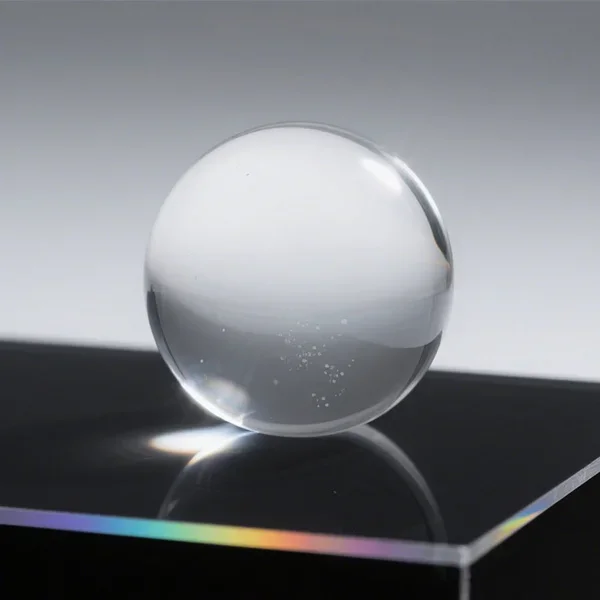
Precision glass balls are typically finished in either polished or matte forms depending on functional requirements. Polished surfaces are used where minimal friction and high visual clarity are required, while matte finishes are preferred in applications where controlled interaction or diffusion effects are needed.
Spherical integrity is maintained through controlled shaping techniques that minimize internal stress and prevent micro-deformation. This balance between geometry and surface quality ensures long-term stability, especially in environments where repetitive motion or continuous contact occurs.
Material performance comparison of glass spheres
Different glass compositions offer distinct performance advantages depending on application conditions. The following table summarizes the key differences between soda lime and borosilicate glass used in precision manufacturing.
| Property | Soda Lime Glass Balls | Borosilicate Glass Balls |
|---|---|---|
| Thermal Resistance | Moderate, up to 230°F | High, up to 450°F continuous |
| Chemical Stability | Good in neutral environments | Excellent in acidic and alkaline conditions |
| Electrical Insulation | Strong dielectric properties | High dielectric strength |
| Mechanical Behavior | Stable under light to medium load | Suitable for thermal shock environments |
| Cost Efficiency | Economical choice | Higher performance grade |
This differentiation allows engineers to select precision glass balls based on performance priorities rather than general material availability.
Manufacturing control of precision glass balls consistency
The production of high-grade glass spheres requires a carefully structured manufacturing process. Each stage contributes to the final performance characteristics of the product.
Raw materials are first selected for purity and consistency to avoid inclusions that may affect structural integrity. The forming stage ensures that each sphere develops a near-perfect geometric shape. Controlled cooling is then applied to relieve internal stress and stabilize the molecular structure.
After initial formation, surfaces undergo refinement to achieve smoothness and dimensional correction. Final inspection includes optical measurement and mechanical verification to ensure compliance with strict tolerance standards.
This multi-stage approach ensures that every batch of precision glass balls maintains consistent quality, regardless of production volume.
Quality assurance framework for precision glass balls manufacturer
Quality assurance is not limited to final inspection but integrated into the entire production cycle. Changzhou Eurasian applies structured control procedures that monitor raw materials, process stability, and finished product performance.
Inspection methods include diameter measurement, roundness evaluation, and surface defect detection. These parameters are analyzed using high-precision metrology instruments capable of detecting microscopic variations.
In addition, batch consistency is continuously evaluated to ensure uniform performance across production runs. This approach is essential for customers who require stable supply chains and predictable material behavior in long-term industrial use.
Industrial integration of precision glass balls
Precision glass spheres are widely integrated into systems where controlled movement or stable positioning is required. Their non-reactive nature and consistent geometry make them suitable for environments involving mechanical interaction, fluid control, and analytical measurement.
In flow regulation systems, they contribute to consistent sealing behavior. In measurement instruments, they provide stable reference points. In laboratory environments, they support controlled experimental conditions where material neutrality is essential.
The adaptability of precision glass balls also extends to high-purity environments where contamination resistance is critical. Their chemical stability ensures that performance remains unaffected even after prolonged exposure to reactive substances.
Procurement considerations for precision glass balls suppliers
When selecting a supplier for precision glass balls, technical consistency and manufacturing capability are more important than nominal specifications. Buyers typically evaluate tolerance stability, batch uniformity, and material traceability.
A reliable precision glass balls manufacturer should also offer flexibility in diameter range and surface finish customization. This allows integration into diverse engineering systems without requiring additional modification.
Changzhou Eurasian supports these requirements by maintaining scalable production capacity and adaptable manufacturing parameters. This ensures that both small-scale technical orders and large-volume industrial demands can be met without compromising quality consistency.
Conclusion
Precision glass spheres represent a specialized category of engineered components where material science, manufacturing accuracy, and surface quality converge. Their performance is defined not only by composition but also by how consistently they are produced and controlled across batches.
Through structured production processes and strict dimensional control, Changzhou Eurasian delivers precision glass balls that meet the expectations of industries requiring stability, accuracy, and long-term reliability. The combination of material selection, tolerance management, and surface refinement ensures that these components remain dependable in a wide range of technical environments.
FAQ
Q1: What defines high-quality precision glass balls?
High-quality glass spheres are defined by strict dimensional tolerance, smooth surface finish, stable material composition, and consistent roundness across production batches.
Q2: Why are tight tolerances important in glass spheres?
Tight tolerances ensure predictable movement, accurate sealing behavior, and stable performance in mechanical and measurement systems.
Q3: What determines the choice between soda lime and borosilicate glass?
The selection depends on operating conditions such as temperature exposure, chemical environment, and required mechanical stability.
Q4: Can precision glass balls maintain stability under repeated use?
Yes, when properly manufactured, they maintain structural integrity and dimensional consistency even under repeated mechanical interaction.
Q5: What factors influence surface quality?
Surface quality is influenced by forming accuracy, polishing techniques, cooling control, and final inspection processes.


