


News


Precision Ceramic Balls for Bearings and Pumps Industrial Grade Supply
In high-performance mechanical environments, rolling elements are no longer simple contact parts but critical components that define efficiency, wear resistance, and long-term stability. Among advanced engineering materials, precision ceramic balls have become essential due to their unique combination of low density, high hardness, and exceptional thermal stability. These characteristics allow them to perform reliably in conditions where metallic alternatives reach their physical limits.
Changzhou Eurasian focuses on engineered ceramic sphere solutions designed for demanding industrial applications. By controlling raw material purity, sintering behavior, and finishing accuracy, the company ensures consistent spherical geometry and predictable mechanical behavior across different ceramic grades.
Material engineering foundation of precision ceramic balls
The performance of ceramic spherical components is strongly influenced by their internal structure and material composition. Compared with steel, ceramic materials exhibit significantly lower density and reduced thermal expansion, which directly improves rotational stability in high-speed systems.
The four major engineering materials used in advanced spherical components include alumina oxide, zirconia oxide, ruby or sapphire-based ceramics, and silicon nitride. Among them, silicon nitride stands out for its ability to maintain structural integrity under extreme mechanical and thermal stress. These material systems form the foundation of modern ceramic precision balls used in precision machinery and energy-intensive applications.
Silicon nitride ceramic balls for high-speed engineering systems
Silicon nitride is widely recognized for its exceptional combination of hardness, toughness, and thermal resistance. Si3N4 ceramic balls maintain strength at temperatures approaching 1000℃ while offering significantly lower density than steel, reducing centrifugal load in high-speed rotation.
These properties make them ideal for environments where friction reduction and durability are critical. Their low thermal conductivity helps minimize heat buildup, while their non-magnetic and non-porous structure ensures stable performance in sensitive mechanical assemblies.
Size ranges from sub-millimeter precision spheres to large-diameter components, supporting flexible integration into hybrid bearings, aerospace assemblies, and gas turbine systems. As a result, silicon nitride is often selected when long service life and minimal lubrication are required.
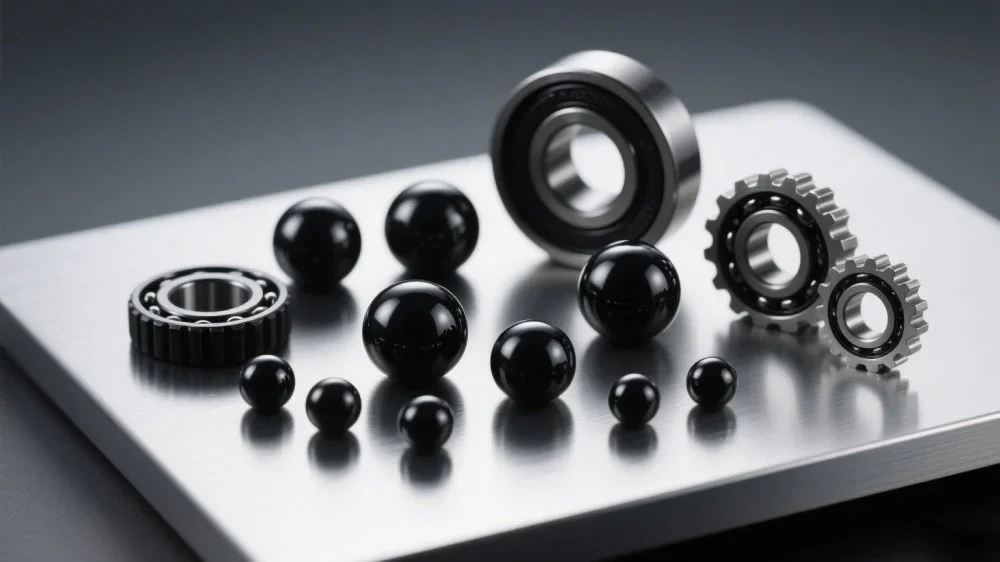
Alumina oxide ceramic balls in chemical and precision flow control
Alumina-based spherical components are valued for their excellent hardness and chemical resistance. With purity levels reaching up to 99.6%, alumina oxide ceramics provide stable performance in aggressive environments where corrosion and abrasion are constant challenges.
These ceramic balls for distilling processes are particularly effective in environments involving chemical interaction and thermal variation. Their non-porous structure prevents contamination, while their high compressive strength supports consistent operation under continuous load.
In engineering applications, alumina spheres are frequently used in pumps, valves, and flow control devices. Their ability to maintain smooth motion with minimal lubrication requirements makes them suitable for precision measurement instruments and fluid regulation systems.
Zirconia oxide ceramic balls for high load and wear resistance
Zirconia-based ceramics offer a unique balance between toughness and hardness due to transformation toughening behavior under stress. This property allows the material to absorb mechanical impact while maintaining structural integrity, making it highly suitable for dynamic load environments.
These chinese ceramic balls are widely used in bearing systems, pumps, and chemical processing equipment where both corrosion resistance and load-bearing capacity are essential. Their chemical inertness ensures stability when exposed to acids, solvents, and caustic substances.
Zirconia also provides excellent wear resistance, which significantly extends service life in continuous operation systems. This makes it a preferred material in industries requiring long-term reliability without frequent maintenance intervention.
Material comparison of ceramic precision balls
Different ceramic materials offer distinct advantages depending on operating conditions. The following table summarizes key performance characteristics:
| Material Type | Density | Thermal Resistance | Key Strength | Typical Application |
|---|---|---|---|---|
| Silicon Nitride | Very low | Up to 1000℃ | High toughness & speed stability | Aerospace, turbines |
| Alumina Oxide | Low | Up to 1748℃ | Chemical and wear resistance | Pumps, valves |
| Zirconia Oxide | Medium-low | Up to 980℃ | High load capacity | Bearings, flow systems |
This differentiation allows engineers to select the most suitable ceramic grade based on mechanical stress, thermal exposure, and chemical conditions.
Manufacturing precision in ceramic ball production
The production of high-quality ceramic spheres requires controlled sintering, precise forming, and advanced finishing techniques. Gas pressure sintering and hot isostatic pressing are commonly used to achieve dense microstructures with minimal internal defects.
Each spherical component undergoes multiple stages of refinement to ensure consistent geometry and surface smoothness. This process reduces friction and improves load distribution during operation.
Changzhou Eurasian operates as a specialized ceramic ball manufacturer, focusing on strict dimensional control and batch consistency. This ensures that every production lot maintains stable performance, even in high-demand industrial environments.
Mechanical performance and functional advantages
Ceramic spherical components provide several engineering advantages over traditional steel materials. Their reduced density lowers centrifugal force, which directly improves performance in high-speed rotation systems.
In addition, their low coefficient of thermal expansion ensures dimensional stability under fluctuating temperature conditions. This prevents deformation and maintains consistent contact geometry during operation.
The combination of high hardness, low friction, and chemical resistance significantly extends operational lifespan. In many applications, ceramic spheres require minimal lubrication, reducing maintenance complexity and improving overall system efficiency.
Industrial integration of precision ceramic balls
Ceramic spherical components are widely integrated into advanced mechanical systems where stability and durability are critical. Their use spans from precision bearings to fluid handling equipment and high-speed rotating machinery.
In bearing assemblies, they reduce friction and improve energy efficiency. In pump systems, they provide stable sealing and wear resistance. In analytical equipment, they ensure consistent measurement accuracy under repeated mechanical stress.
Their adaptability across different industrial sectors highlights the importance of material selection in achieving optimal performance outcomes.
Engineering considerations for ceramic ball selection
Selecting appropriate ceramic materials requires evaluation of mechanical load, operating temperature, chemical exposure, and rotational speed. Each material type offers a different balance between toughness, hardness, and thermal resistance.
For high-speed applications, silicon nitride is often preferred. For chemical resistance and thermal endurance, alumina is commonly selected. For high load and wear-intensive environments, zirconia provides the best balance of durability and impact resistance.
Changzhou Eurasian provides technical guidance to ensure material selection aligns with operational requirements, reducing risk of premature wear or failure.
Conclusion
Precision ceramic spherical components represent a significant advancement in engineering materials, combining low density, high hardness, and excellent thermal stability. Their performance advantages enable improved efficiency and extended service life in demanding industrial systems.
Through controlled manufacturing and material optimization, Changzhou Eurasian delivers consistent, high-quality solutions across multiple ceramic grades. Whether used in high-speed machinery, chemical processing, or precision measurement systems, these components provide reliable performance under challenging conditions.
FAQ
Q1: What makes precision ceramic balls different from steel balls?
They offer lower density, higher hardness, better thermal stability, and significantly reduced friction compared to steel alternatives.
Q2: Why is silicon nitride widely used in high-speed applications?
Because it combines low weight, high strength, and excellent thermal resistance, making it ideal for high rotational speed environments.
Q3: Where are alumina ceramic balls commonly used?
They are widely used in pumps, valves, chemical systems, and precision flow control equipment due to their chemical resistance.
Q4: What is the advantage of zirconia ceramic balls?
They provide high toughness, excellent wear resistance, and strong load-bearing capacity under stress conditions.
Q5: Can ceramic balls operate with minimal lubrication?
Yes, their low friction and high hardness allow many applications to function with reduced lubrication requirements.


