


News

Low Carbon Steel Balls for Case Hardening and Shock Load Applications
Why Low Carbon Steel Balls Matter in Case Hardening Applications
Selecting the right steel ball material is not simply a matter of choosing hardness or dimensional accuracy. In mechanical components exposed to repeated movement, moderate loads, impact, and surface friction, the relationship between surface hardness and internal toughness can have a direct effect on service life. Low carbon steel balls are particularly useful when manufacturers need a hard, wear-resistant outer layer without making the entire ball excessively brittle. Through controlled case hardening, the surface can withstand repeated contact while the softer core provides better resistance to shock loading.
This combination makes case hardened carbon steel balls a practical choice for many motion and support components. Instead of relying only on high overall hardness, engineers can use surface treatment to place hardness where it is most valuable. This approach is especially relevant for castors, conveyors, drawer slides, seat slides, bicycles, roller mechanisms, and other components operating under moderate mechanical loads. For international buyers, understanding how carbon content, heat treatment, case depth, and precision interact can make material selection more accurate and procurement more predictable.
How Case Hardening Improves Carbon Steel Ball Performance
The main advantage of case hardening is the ability to create different mechanical characteristics between the outer surface and the interior of the ball. A properly treated surface develops high hardness and improved resistance to abrasive and contact wear, while the core remains comparatively softer and tougher. This structure helps the ball tolerate repeated impact and mechanical shock without sacrificing the surface performance required for continuous movement.
For low carbon steel balls for industrial applications, this balance is particularly valuable. Low-carbon material has relatively good ductility before treatment, making it suitable for manufacturing processes that require controlled forming and subsequent hardening. After carburizing and appropriate heat treatment, the carbon-enriched surface can achieve high hardness while maintaining a tougher interior. The result is a component designed to handle both surface contact and mechanical loading more effectively than a uniformly hardened material in applications where impact resistance is important.
Surface Hardness and Core Toughness Work Together
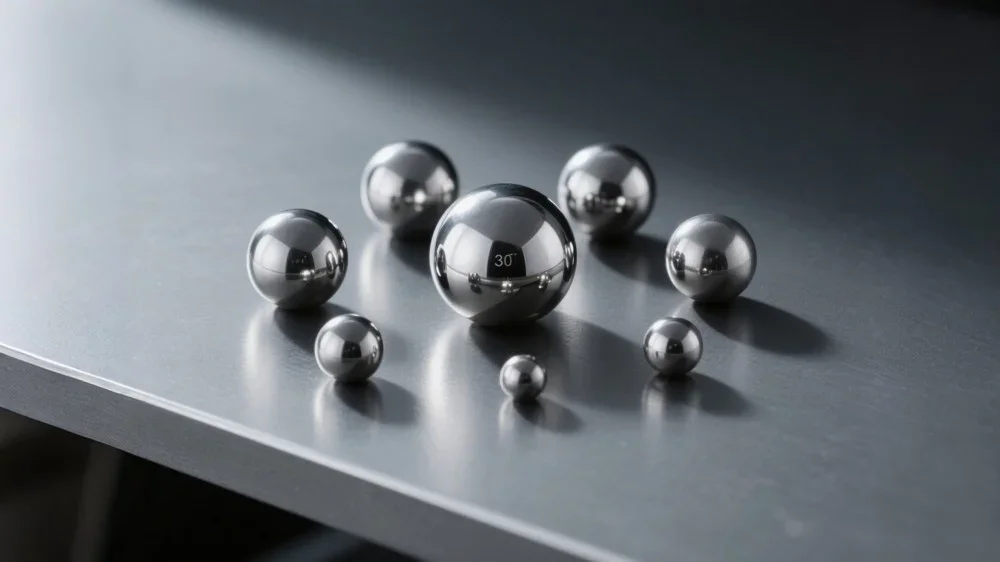
A common mistake in steel ball selection is to evaluate hardness as an isolated value. High hardness can improve resistance to indentation and wear, but excessive hardness throughout the entire section may reduce toughness under impact. Case hardened balls address this problem by concentrating hardness near the working surface while preserving greater toughness toward the center.
This characteristic is important in components that experience intermittent shock, vibration, or changes in load direction. A case hardened carbon steel ball can provide a durable contact surface while its core helps absorb mechanical energy. The practical benefit is not simply higher hardness; it is a more balanced mechanical structure suited to applications where both wear resistance and shock resistance are required.
Choosing Low Carbon Steel Balls for Moderate Loads
Not every mechanical application requires premium bearing steel or fully hardened alloy steel. For moderate-load components, using an appropriate low-carbon grade with controlled case hardening can provide a more economical balance between manufacturing cost and functional performance. This is one reason these balls remain relevant in general industrial hardware and motion-related components.
When selecting low carbon steel balls, buyers should consider the actual operating conditions rather than choosing material solely from a catalog description. Load level, contact pressure, movement frequency, lubrication, environmental exposure, required precision, and expected service life all influence the appropriate material and treatment. A properly matched ball can perform efficiently without introducing unnecessary material or processing costs.
The required case depth should also correspond to ball diameter and operating conditions. A very shallow hardened layer may not provide sufficient support under repeated contact, while an unnecessarily deep case may add processing requirements without delivering meaningful performance benefits. Controlled heat treatment therefore plays an important role in maintaining a consistent relationship between surface hardness and core properties.
Where Case Hardened Carbon Steel Balls Are Commonly Used
Case hardened steel balls are well suited to components where rolling, sliding, guiding, or positioning occurs under moderate mechanical loads. Their combination of surface durability and core toughness allows them to work in a broad range of industrial products without requiring the material characteristics of specialized bearing steel.
Typical applications include castors, conveyors, roller equipment, drawer slides, seat slides, bicycles, and other mechanical assemblies. In these products, the ball may experience repeated contact, localized pressure, vibration, or occasional impact. A hard surface helps reduce premature wear, while the tougher core provides additional protection against damage caused by sudden loading.
The application environment should always be considered. Carbon steel generally offers less corrosion resistance than stainless steel, so case hardened carbon steel balls are more appropriate for dry or controlled environments unless additional corrosion protection is provided. Where moisture, chemicals, or aggressive media are unavoidable, stainless steel or another corrosion-resistant material may be more suitable.
Material Selection Beyond Carbon Content
Carbon content is one of the most important factors influencing how a steel ball responds to heat treatment, but it should not be considered independently. Low-carbon materials are generally selected when manufacturers need a relatively ductile base material that can develop a hardened surface through carburizing or similar treatment. Higher-carbon steels can achieve high hardness throughout the ball after appropriate heat treatment and are therefore more suitable for different load and wear conditions.
The following comparison helps explain the functional difference without reducing material selection to a simple hardness ranking.
| Material approach | Typical characteristic | Suitable application direction |
|---|---|---|
| Low-carbon case hardened steel | Hard surface with tougher core | Moderate loads, shock and surface wear |
| Higher-carbon through hardened steel | High hardness throughout | Higher loads and extended wear requirements |
| Stainless steel | Better corrosion resistance | Moist or corrosive environments |
| Bearing-grade steel | High precision and load capability | Precision bearing and demanding motion applications |
For procurement teams, the most suitable choice depends on the balance between wear resistance, impact tolerance, precision, corrosion resistance, production cost, and expected operating life. This broader evaluation can prevent over-specification while ensuring that the selected ball performs reliably in its intended component.
Precision Still Matters After Heat Treatment
Material performance alone cannot compensate for poor dimensional control. Steel balls used in moving components must maintain suitable diameter consistency, roundness, surface quality, and finish for the intended application. Heat treatment must therefore be integrated with forming, grinding, finishing, cleaning, and inspection processes rather than treated as an isolated production step.
For buyers sourcing precision low carbon steel balls, consistency between batches is especially important. Small variations in diameter or surface condition can affect contact behavior, friction, noise, and assembly performance. Professional manufacturing therefore requires inspection procedures capable of controlling both metallurgical characteristics and geometric accuracy.
Surface inspection is equally significant because scratches, dents, pits, or other imperfections may become concentrated stress points during repeated operation. Proper grinding and finishing help produce a smoother working surface, while final inspection confirms that the finished balls meet the specified requirements.
Why Heat Treatment Expertise Influences Ball Quality
Heat treatment is one of the most critical stages in producing case hardened carbon steel balls. Temperature control, carburizing conditions, treatment duration, cooling, and subsequent processing can all influence hardness distribution and microstructure. Inconsistent treatment may result in variations between batches, even when the starting material is the same.
For this reason, experienced manufacturers place strong emphasis on controlled heat treatment and inspection. Changzhou Eurasian combines carbon steel ball manufacturing with broader metallurgical experience in precision steel balls and heat-treated materials. Its production and quality management practices are supported by IATF 16949:2016 certification and CQI-9-based heat treatment expertise, providing a structured approach to process consistency and inspection.
This matters particularly for overseas OEM and industrial buyers that need repeatable performance across multiple purchase orders. Consistent manufacturing is not only about meeting a specification once; it is about maintaining dimensional, hardness, and surface quality throughout continuing production.
Working with Carbon Steel Ball Manufacturer
Choosing a supplier involves more than comparing the unit price of steel balls. A qualified carbon steel ball manufacturer should be able to discuss material selection, heat treatment, dimensional requirements, precision grade, packaging, inspection, and application conditions. This technical communication becomes especially important when the balls are being integrated into assemblies with defined load and wear requirements.
Changzhou Eurasian provides carbon steel, stainless steel, chrome steel, aluminum, and other precision ball solutions from one manufacturing source. This broader capability can simplify supplier management when different projects require different ball materials. Buyers can also communicate requirements such as diameter, grade, hardness, case depth, quantity, packaging, and application conditions before production begins.
For export procurement, packaging and documentation are also part of the supply process. Consistent packaging helps protect finished balls during transportation, while clear inspection documentation can support incoming quality checks. Flexible quantities and customized packaging can further help manufacturers manage both trial purchasing and larger production programs.
What to Specify When Ordering Case Hardened Balls
A clear technical inquiry helps a manufacturer recommend the appropriate ball construction and provide an accurate quotation. Instead of requesting only a diameter and quantity, buyers should provide as much information as possible about the working conditions and performance requirements.
Important information normally includes:
Ball diameter and dimensional tolerance
Required precision or grade
Low-carbon material requirement
Surface hardness requirement
Minimum case depth where applicable
Expected load and operating conditions
Surface finish requirements
Quantity and purchasing frequency
Packaging requirements
Application and environmental conditions
Providing these details early can reduce communication delays and prevent unsuitable material selection. It also allows the manufacturer to evaluate whether case hardened carbon steel is the most appropriate option or whether a through-hardened or corrosion-resistant material would provide better performance.
Balancing Cost, Wear and Service Life
One of the strongest reasons to consider low-carbon case hardened steel is its ability to provide useful surface performance without the cost associated with some higher-grade materials. For moderate-load applications, the combination of a hardened surface and tougher core can offer an effective balance between manufacturing economics and functional requirements.
However, cost should always be evaluated against service conditions. Selecting the cheapest steel ball may lead to faster wear, dimensional deterioration, or premature replacement if the material does not match the application. Conversely, selecting a highly specialized material for a moderate-duty component may increase purchasing costs without producing a meaningful operational benefit.
The better approach is to define the actual mechanical requirements first and then select the material and treatment accordingly. This application-driven method makes low carbon steel balls a practical option where surface wear resistance, shock tolerance, precision, and cost efficiency need to work together.
FAQ
Are low carbon steel balls suitable for shock loads?
Yes. When properly case hardened, low carbon steel balls can provide a hard wear-resistant surface while retaining a comparatively tougher core. This structure makes them suitable for applications involving moderate loads and intermittent shock or impact.
What is the main benefit of case hardening?
Case hardening increases surface hardness without making the entire ball equally hard. The resulting combination of a wear-resistant outer layer and tougher core can provide a useful balance between surface durability and resistance to mechanical shock.
Are these balls suitable for high-load bearing applications?
They can be suitable for certain moderate-load mechanical components, but demanding high-load, high-speed, or long-life bearing applications may require through-hardened bearing steel or another specialized material. The correct choice depends on load, precision, speed, lubrication, and service conditions.
How should buyers specify case hardened carbon steel balls?
Buyers should normally provide ball diameter, required precision, quantity, hardness, case depth where applicable, application conditions, surface requirements, and packaging preferences. Providing these details allows the manufacturer to evaluate the appropriate material and processing route.
How do carbon steel balls compare with stainless steel balls?
Carbon steel generally provides good strength and cost efficiency but has lower corrosion resistance than stainless steel. Case hardened carbon steel is therefore particularly suitable for dry or controlled environments, while stainless steel is often preferred when moisture or corrosive media are major concerns.
Why is manufacturing consistency important?
Consistent forming, heat treatment, grinding, and inspection help maintain stable diameter, roundness, hardness, surface quality, and case characteristics between production batches. This is particularly important for OEM customers that require predictable component performance over repeated orders.
For manufacturers and distributors seeking a practical combination of surface wear resistance, core toughness, dimensional consistency, and cost efficiency, case hardened low-carbon steel remains a valuable material option. With appropriate heat treatment and precision finishing, these balls can support a wide range of moderate-load motion and mechanical applications while offering greater flexibility in material selection. Changzhou Eurasian's experience in precision ball manufacturing and controlled heat treatment provides overseas buyers with a technical supply partner capable of supporting both specification-driven and volume production requirements.


