


News


HDPE plastic balls for water treatment media flotation systems
Water conservation and quality control have become central concerns across municipal, agricultural, and industrial sectors. Among the most effective surface technologies developed in recent years, floating polymer sphere systems have gained significant attention for their ability to regulate evaporation, stabilize water chemistry, and improve environmental resilience. In particular, HDPE plastic balls have emerged as a reliable engineering solution due to their durability, adaptability, and long-term operational stability in demanding water environments.
Unlike traditional covers or mechanical sealing systems, these floating elements operate continuously at the water-air interface, forming a dynamic protective layer that responds naturally to environmental changes. This makes them especially valuable in large-scale storage systems where flexibility and low maintenance are critical performance requirements. In this blog post, Changzhou Eurasian, as high performance custom plastic balls china manufacturer, will share the advantages of HDPE plastic balls for water treatment media flotation systems.
Engineering Principles Behind HDPE Plastic Balls in Surface Coverage Systems
The functional design of floating coverage technology is rooted in simple but highly effective physical principles. When HDPE plastic balls are deployed across a water surface, they form a semi-mobile barrier that reduces direct solar radiation exposure and minimizes wind-driven evaporation. The spherical geometry allows each unit to move independently while still maintaining a collectively dense surface layer.
This balance between mobility and coverage is essential. A rigid cover would struggle to adapt to fluctuating water levels, while fully open systems would fail to provide adequate protection. The engineered spacing between individual spheres ensures airflow regulation while limiting thermal exchange between water and atmosphere.
From a systems engineering perspective, this approach also reduces stress concentrations that often occur in fixed membrane structures. Instead of relying on tension or anchoring points, the floating configuration distributes forces evenly across the entire surface area.
Surface Interaction and Evaporation Control Mechanisms
One of the most important advantages of floating coverage systems is their ability to reduce evaporation without interfering with underlying water operations. By forming a near-continuous layer, these spheres significantly limit the amount of exposed surface area available for phase change.
The mechanism is not purely physical shading. The micro-gap structure created between individual units slows down convective air movement across the water surface. This reduces the rate at which heat is transferred into the water body during peak daytime conditions and also minimizes nighttime heat loss.
Over time, this stabilization effect leads to more consistent water levels, which is particularly important in regions experiencing seasonal drought or irregular rainfall patterns. It also contributes to improved operational predictability for storage facilities that depend on stable water volumes.
Water Chemistry Stabilization and UV Protection Functions
Beyond evaporation control, floating sphere systems play an important role in protecting water quality. Continuous exposure to ultraviolet radiation can accelerate chemical reactions in stored water, leading to unwanted byproducts and degradation of treatment stability.
The protective layer formed by these spheres significantly reduces UV penetration, thereby limiting photochemical reactions that contribute to compound formation such as bromate. In addition, reduced light exposure helps suppress biological growth, particularly algae, which relies heavily on sunlight for photosynthesis.
Thermal buffering is another indirect benefit. By reducing direct solar absorption, water temperature fluctuations become less extreme, creating a more stable environment for downstream treatment processes. This stability reduces chemical demand in many systems and helps maintain more consistent operational conditions.
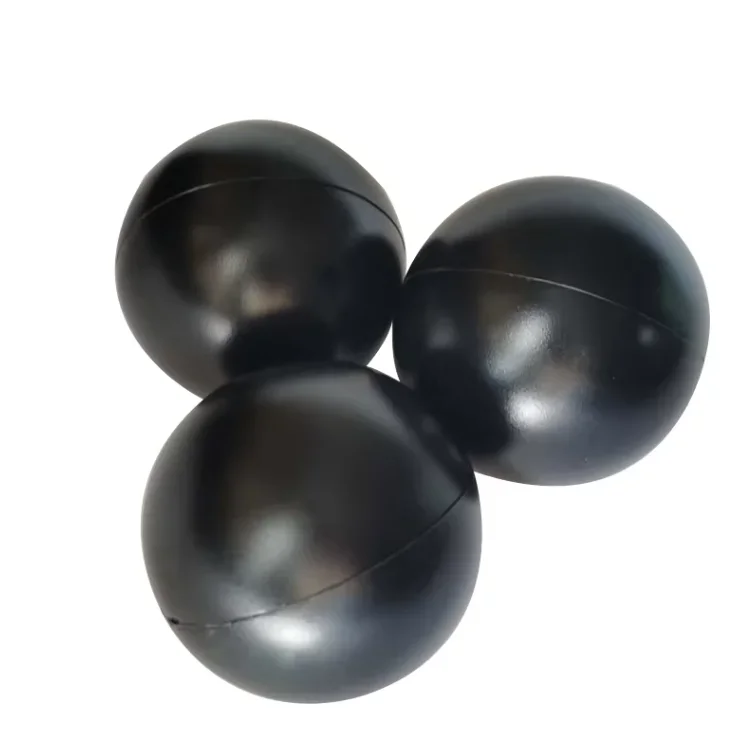
Structural Behavior of Hollow Plastic Ball Systems in Fluid Environments
In many flotation applications, the performance of each unit depends heavily on internal structure and material distribution. A well-designed hollow plastic ball is engineered to maintain buoyancy while resisting deformation under environmental stressors such as wind, wave motion, and temperature cycling.
The hollow internal cavity reduces overall density while maintaining sufficient wall thickness for mechanical integrity. This allows the spheres to remain stable even in large reservoirs where surface movement can be unpredictable. The internal air chamber also contributes to thermal insulation, reducing heat transfer between water and atmosphere.
Material selection plays a crucial role in long-term performance. High-density polyethylene is commonly used due to its resistance to UV degradation, chemical exposure, and physical fatigue. When properly stabilized with additives, it can maintain structural integrity over extended operational lifespans without significant performance loss.
Operational Efficiency in Large-Scale Water Infrastructure Systems
In industrial and municipal water systems, scalability is a critical factor. Floating coverage technology must perform consistently across varying surface areas, from small retention basins to extensive reservoir networks.
Within this context, industrial plastic balls are designed to support high-density deployment without compromising movement flexibility. Their uniform geometry ensures predictable surface behavior, which simplifies system design and reduces the need for complex engineering adjustments.
Operational efficiency is also enhanced through passive deployment methods. Unlike mechanical covers or automated systems, these spheres require no active control mechanisms once installed. This reduces energy consumption and eliminates mechanical failure points, which are often significant cost drivers in long-term infrastructure maintenance.
Additionally, their modular nature allows incremental expansion. Facilities can scale coverage gradually based on seasonal demand or capacity changes without redesigning the entire system.
Material Performance in Demanding Environmental Conditions
Environmental exposure presents one of the greatest challenges for floating infrastructure components. UV radiation, temperature fluctuations, chemical contact, and mechanical abrasion all contribute to material degradation over time.
High-performance polymer systems are engineered specifically to withstand these stresses. Stabilized polyethylene formulations maintain flexibility even under extreme temperature ranges, preventing cracking or brittleness. The smooth surface also reduces biofouling, limiting the accumulation of organic matter.
Wind and wave dynamics introduce additional mechanical loads, particularly in open reservoirs. The spherical design minimizes drag forces by allowing wind to flow around the structure rather than against flat surfaces. This reduces displacement stress and helps maintain consistent coverage distribution across the water body.
Customization Trends in Modern Water Surface Engineering
As water infrastructure becomes more specialized, there is increasing demand for adaptable design solutions. The development of custom plastic balls has enabled engineers to tailor diameter, wall thickness, buoyancy levels, and material formulations according to specific operational requirements.
Customization allows optimization for different water chemistries, temperature ranges, and environmental conditions. For example, systems used in high-salinity environments may require modified polymer blends to resist chemical interaction, while colder climates may prioritize impact resistance and thermal stability.
This design flexibility also supports integration with hybrid systems, where floating coverage is combined with sensors or monitoring devices to enhance data collection and operational control. Such adaptability is becoming increasingly important in smart water management frameworks.
Maintenance-Free Deployment and Lifecycle Efficiency Considerations
One of the most practical advantages of floating sphere systems is their extremely low maintenance requirement. Once deployed, the system operates passively without mechanical intervention or routine servicing.
Over time, minor repositioning occurs naturally due to wind and water movement, ensuring continuous redistribution across the surface. This self-adjusting behavior eliminates the need for manual reconfiguration.
From a lifecycle perspective, systems built on floating polymer technology offer significant operational savings. Reduced evaporation, lower chemical consumption, and minimal maintenance requirements contribute to long-term cost efficiency. Additionally, materials are typically recyclable, supporting sustainability objectives in modern infrastructure planning.
The absence of mechanical components also reduces failure risk, making these systems particularly suitable for remote or hard-to-access facilities where maintenance operations are costly or logistically challenging.
Conclusion
Floating polymer sphere technology represents a practical and scalable approach to modern water surface management. Through careful material engineering, geometric optimization, and environmental adaptability, these systems provide a reliable method for controlling evaporation, stabilizing water quality, and improving infrastructure efficiency.
As water resource challenges continue to intensify globally, solutions based on passive, durable, and scalable materials will play an increasingly important role in sustainable water management strategies.
Frequently Asked Questions (FAQ)
1. What are HDPE plastic balls used for in water surface applications?
HDPE plastic balls are designed to float on water surfaces to reduce evaporation, block UV radiation, and help maintain stable water quality. They are widely used in reservoirs, industrial tanks, agricultural ponds, and wastewater treatment systems as a passive surface coverage solution.
2. How do floating HDPE plastic balls help reduce water evaporation?
By forming a continuous floating layer, the balls significantly reduce direct sunlight exposure and limit wind-driven surface movement. This dual effect lowers heat transfer and slows down the evaporation rate, helping conserve large volumes of stored water over time.
3. Are hollow plastic ball systems safe for drinking water storage?
Yes. When manufactured with food-grade, UV-stabilized HDPE, hollow plastic ball systems are non-toxic and safe for potable water applications. They are commonly used in municipal reservoirs to improve water quality while meeting safety standards.
4. What environmental benefits do industrial plastic balls provide?
Industrial plastic balls help reduce algae growth by blocking sunlight, minimize chemical usage in water treatment, and prevent contamination from debris, birds, and airborne pollutants. They also contribute to odor control in wastewater and industrial storage systems.
5. How long do custom plastic balls typically last in outdoor environments?
High-quality custom plastic balls made from UV-resistant HDPE can last over 10 years under normal operating conditions. Their durability depends on environmental exposure, water chemistry, and maintenance conditions, but they are generally designed for long-term, maintenance-free performance.


